
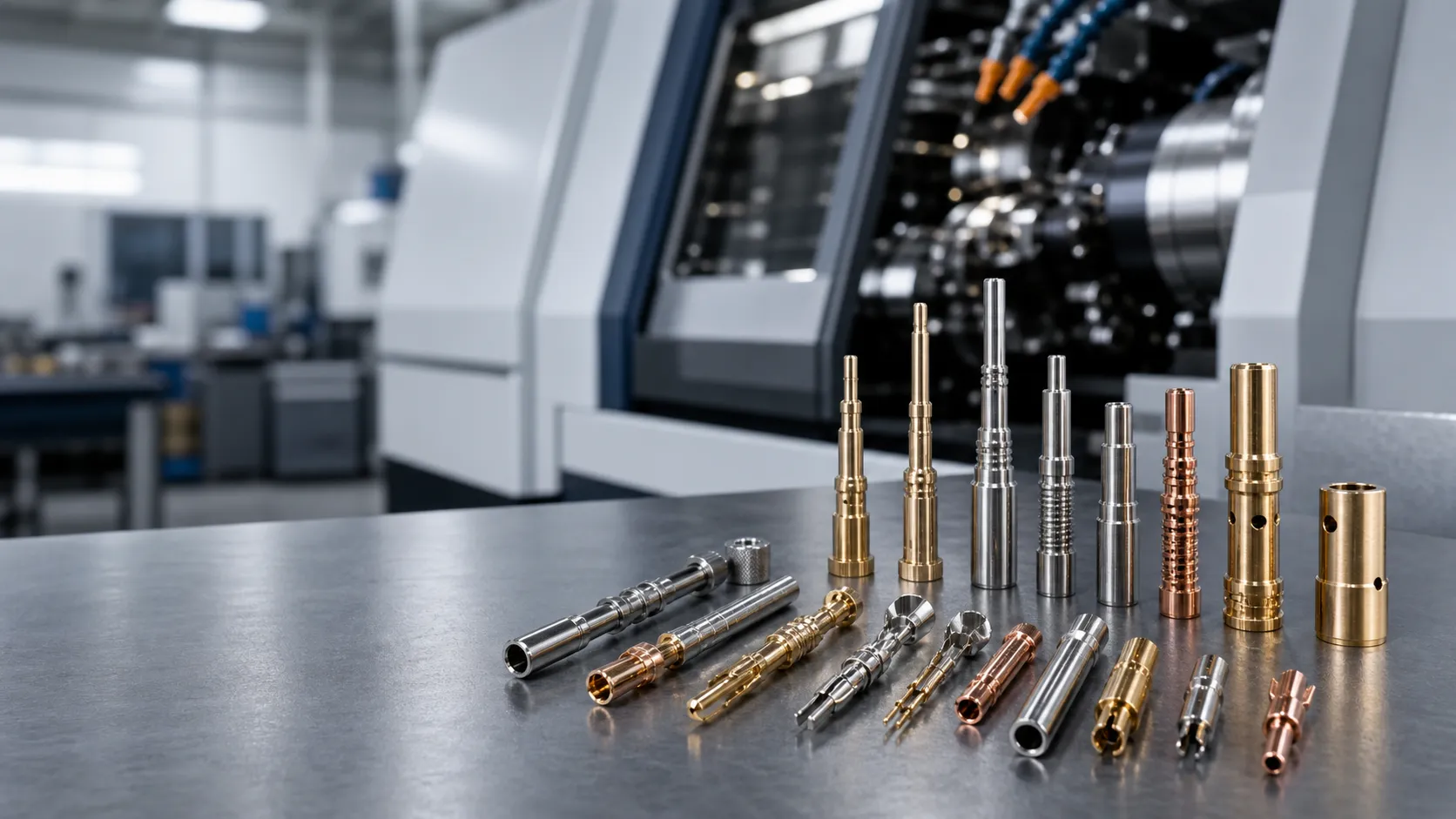
Connector pins and miniature contacts look simple from the outside. In production, they are not simple at all.
A small pin may need a precise outside diameter, stable concentricity, clean grooves, controlled burrs, reliable plating allowance, and consistent performance across thousands or millions of pieces. For automotive electronics, communication equipment, industrial connectors, and medical device components, these small turned parts often become critical to assembly reliability.
This is where Swiss CNC machining becomes a strong fit.
Connector components are usually small, slender, and feature-dense. A typical part may include several diameters, grooves, chamfers, threads, slots, crimping areas, or contact surfaces. The material may be brass, copper alloy, stainless steel, aluminum, titanium, or an engineering plastic, depending on the final application.
The main risks are not only dimensional tolerance. Buyers also care about:
A conventional CNC lathe can handle many round parts. But when the diameter becomes small, the length-to-diameter ratio increases, or the part requires several precise features in one setup, Swiss-type machining often becomes the more efficient and stable process.
Swiss machining supports the bar stock close to the cutting tool through a guide bushing. This reduces unsupported length during cutting, which helps lower deflection risk on slender parts.
For connector pins and miniature contacts, that matters. Less deflection can support better dimensional control, more stable concentricity, and cleaner feature transitions. Live tooling and sub-spindle operations can also allow multiple features to be completed in one production flow, reducing secondary handling and alignment risk.
For buyers, the practical value is clear: fewer process steps, better repeatability, and a stronger basis for batch consistency.
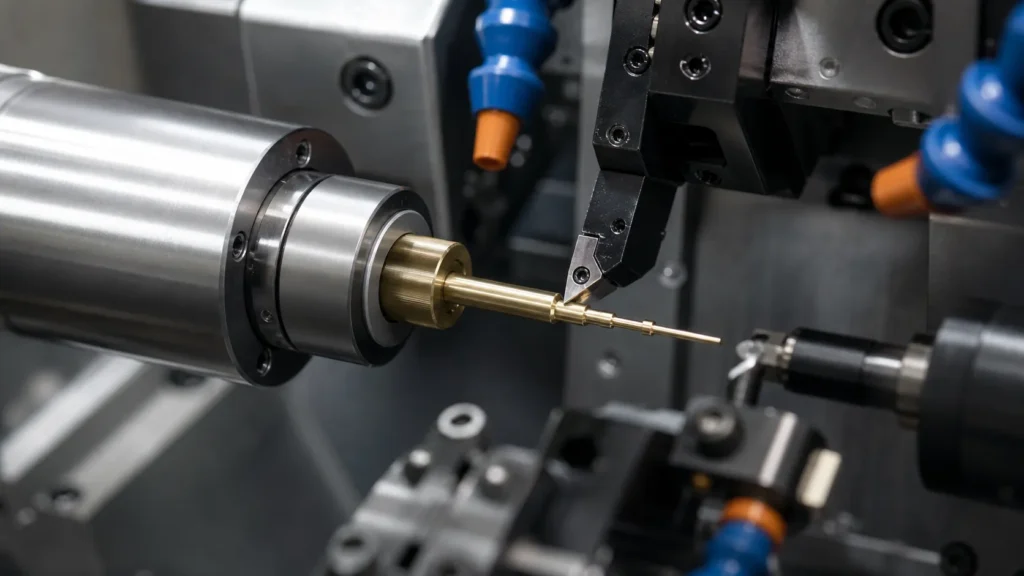
Swiss CNC machining is especially suitable for:
These components are common in automotive electronics, telecommunications, industrial controls, consumer electronics, and medical device assemblies.
Material choice has a direct impact on machinability, burr formation, surface finish, and post-processing. Brass and copper alloys are common in electrical contact applications because of conductivity and plating compatibility. Stainless steel may be selected for strength or corrosion resistance. Titanium and engineering plastics may be used in specialized device applications.
At Aizhuo Precision CNC Machining, material and process planning are treated as part of the manufacturing review. The goal is not only to cut the part to print, but to evaluate the relationship between geometry, material, tolerance, inspection method, and production stability.
For connector components, this is especially important when the part requires plating, passivation, deburring, or tight surface requirements after machining.
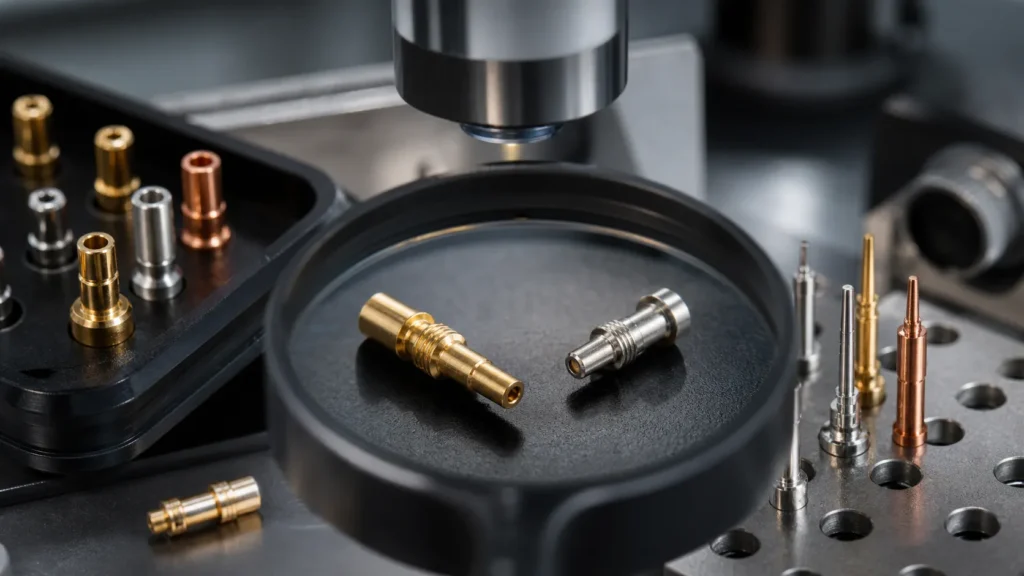
Many RFQ discussions begin with a tolerance number. But a reliable connector pin project usually needs a broader engineering review.
A drawing may specify diameter tolerance, but the real functional concern may be insertion force, contact reliability, plating thickness, alignment, or assembly repeatability. A groove may be dimensionally acceptable, but burrs can still create downstream assembly issues. A turned surface may meet size requirements, but roughness or tool marks may affect mating performance.
That is why DFM review is valuable before production. Key questions include:
When these questions are addressed early, buyers can reduce avoidable cost, rework, and production delays.
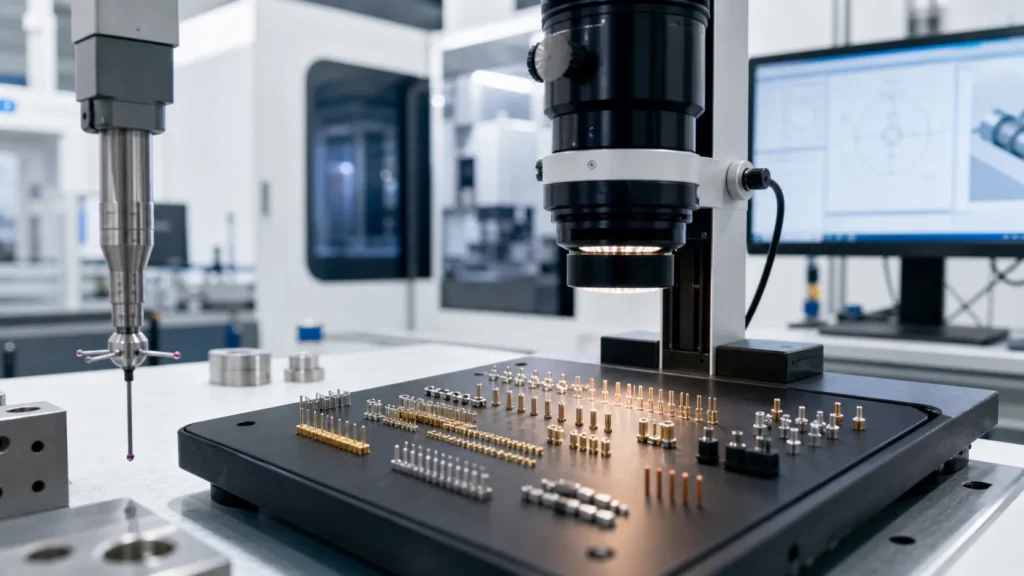
For connector pins and miniature contacts, inspection should match the risk of the part. Depending on project requirements, this may include first article inspection, CMM inspection, optical measurement, roundness or concentricity verification, surface roughness checks, and lot-level traceability.
Aizhuo Precision CNC Machining focuses on controlled batch consistency rather than unsupported absolute claims. This matters for overseas buyers who need stable production, clear documentation, and practical engineering communication.
Swiss machining is worth evaluating when your part has one or more of these conditions:
If the part is a simple large-diameter component, conventional turning may be enough. If the part is small, complex, slender, or produced in volume, Swiss-type machining can often provide better process stability.
A strong Swiss machining supplier should do more than quote a price from a drawing. For connector pins and miniature contacts, the supplier should understand material selection, tooling strategy, burr control, plating allowance, inspection planning, and batch production risk.
AZ Precision CNC Machining supports precision CNC machining, Swiss-type machining, CNC turning, CNC milling, and related manufacturing processes for demanding industrial applications. For connector components, our team can review drawings, identify manufacturing risks, and recommend a practical route from prototype to batch production.
Need connector pins, miniature contacts, ferrules, or precision sleeves? Upload your drawing for a DFM review and manufacturing evaluation.