Вставное литье и овермолдинг: Искусство интеграции точных металлов с ЧПУ и пластмасс
Администратор
11 мая 2026 года
In modern engineering, some of the most innovative product designs require the strength of metal combined with the ergonomics, insulation, or sealing properties of plastics and elastomers.
However, sourcing these hybrid components often creates an engineering nightmare. When you machine a custom metal insert at one facility and ship it to another for injection molding, you open the door to tolerance mismatches, shipping delays, and the dreaded “vendor finger-pointing” when a part fails.
At Aizhuo Precision, we’ve eliminated this risk. By housing 186 advanced CNC machining centers alongside our cleanroom injection and LSR (Liquid Silicone Rubber) molding presses under one roof, we transform complex metal-to-plastic integration from a supply chain headache into a seamless, single-source solution.
Here is an engineer’s guide to mastering insert molding and overmolding, and why keeping both processes under one roof is your ultimate competitive advantage.
Decoding the Processes: Insert Molding vs. Overmolding
While often used interchangeably, these two processes serve distinct functional purposes in mechanical design:
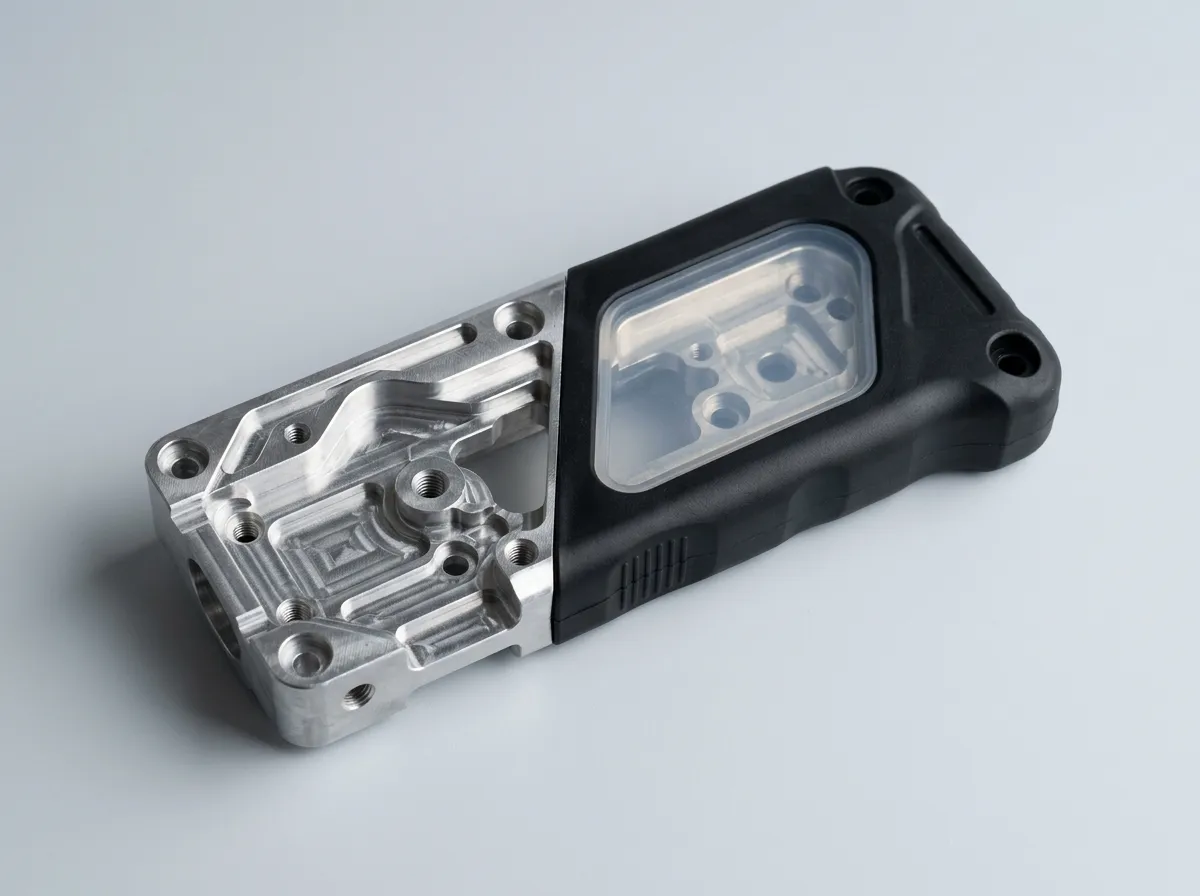
Insert Molding: This process involves placing a pre-machined rigid component (usually a CNC-turned metal insert, threaded brass nut, or stainless steel shaft) into the mold cavity before the thermoplastic is injected. The plastic flows around the insert, creating a single, robust encapsulated part.
Overmolding: This is a multi-step process where a secondary material (like a soft TPE or Medical-Grade LSR) is molded over a rigid substrate (either a machined metal component or a previously molded rigid plastic part). It is typically used to add soft-touch grips, vibration dampening, or hermetic seals.
The Aizhuo Advantage: We don’t rely on off-the-shelf, standard inserts. Our core capability lies in CNC machining highly complex, custom metal substrates—down to sub-micron tolerances—and perfectly molding them with high-performance engineering resins like PEEK, PPS, or LSR.
Crucial DFM Guidelines for Metal-to-Plastic Integration
Designing a hybrid part requires balancing the rigid, absolute dimensions of machined metals with the shrink rates and flow behaviors of molten plastics. Here are the top DFM (Design for Manufacturing) rules our engineers look for:
Maximize Pull-Out and Torque Strength
Plastics shrink as they cool, which naturally grips the metal insert. However, a smooth metal surface will inevitably pull out or spin under load.
Actionable Tip: Always design mechanical interlocks on the CNC machined insert. Use diamond knurling for components requiring high torque resistance (preventing rotational spin), and undercuts or deep grooves for high pull-out strength.
Avoid Sharp Corners on the Metal Substrate
Sharp internal or external corners on the machined insert create severe stress concentrations in the surrounding plastic as it cools and shrinks, leading to cracking over time.
Actionable Tip: Design generous radii (at least 0.5mm) on all edges of the metal insert that will be encapsulated by plastic.
Mind the Wall Thickness
If the plastic wall surrounding the metal insert is too thin, it will crack during the cooling phase or fail in the field.
Actionable Tip: As a general rule, the plastic wall thickness surrounding the insert should be equal to or greater than the diameter of the insert itself (e.g., a 4mm diameter insert needs at least a 4mm plastic wall).
Why Single-Source Manufacturing Matters
Splitting a hybrid project across a “CNC shop” and an “Injection Molding shop” is a recipe for dimensional drift. Here is why consolidating these processes at Aizhuo Precision guarantees zero-defect compliance:
Perfecting the Tolerance Stack-up: A CNC-machined insert with a +0.02mm deviation might technically pass the CNC shop’s FQC. But when placed into an injection mold designed for a nominal dimension, that +0.02mm can cause mold damage, severe flash, or improper sealing. Because we design the mold and machine the insert in the same facility, our tooling engineers and CNC machinists collaborate to lock in the exact nominal dimensions.
No Contamination Risks: Metal parts shipped from a machine shop often arrive coated in cutting fluids or anti-rust oils, which will completely ruin the chemical bonding during overmolding. We wash, passivate, and immediately transfer CNC components to our molding cleanrooms, ensuring pristine surface energy for optimal adhesion.
Automotive-Grade Traceability: Operating under stringent ISO 9001 and IATF 16949 workflows, we apply automated optical inspection (AOI) to both the machined insert and the final molded assembly. If a defect occurs, we don’t wait weeks for a supplier investigation—we walk across the factory floor and calibrate the machine instantly.
Real-World Applications
Our integrated manufacturing capabilities serve highly regulated industries where failure is not an option:
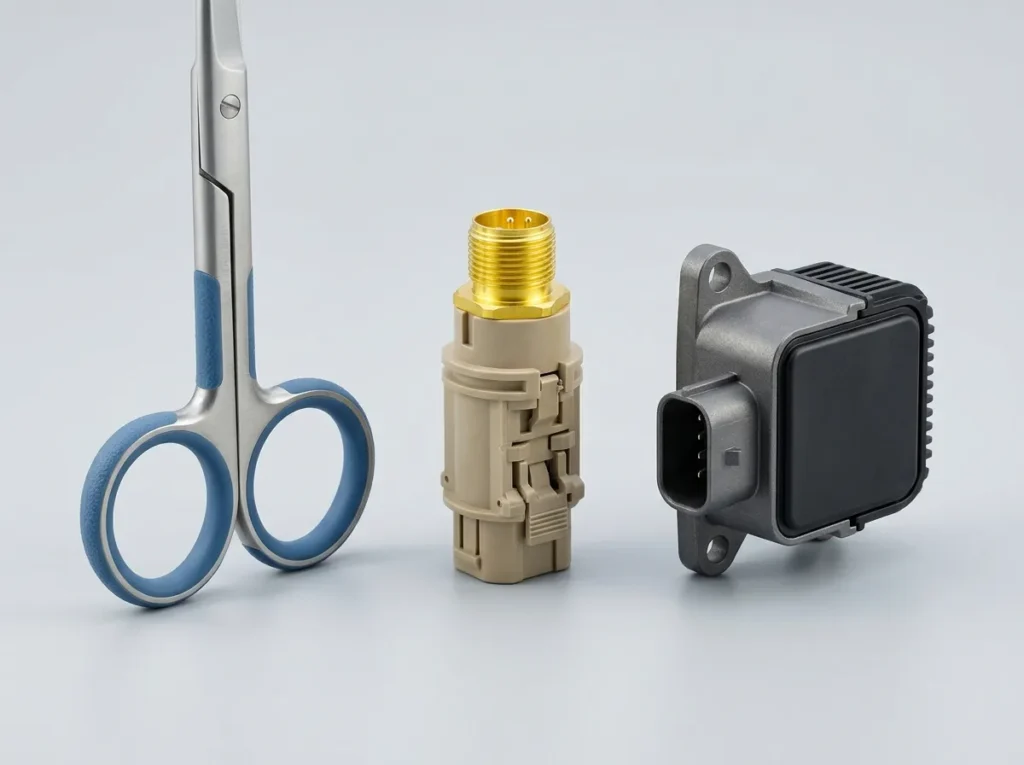
Medical & Surgical Devices: Overmolding custom 316L stainless steel surgical instruments with Medical-Grade LSR for autoclavable, biocompatible, and ergonomic grips.
Telecommunications & 5G: Insert molding highly conductive, CNC-turned copper pins into PEEK or PPS insulators for durable, high-frequency RF connectors.
Automotive & EV: Encapsulating complex aluminum sensor housings with impact-resistant plastics to protect internal electronics from harsh under-hood environments.
Ready to Streamline Your Hybrid Manufacturing?
Stop compromising your designs to fit a fragmented supply chain. Whether you need rapid prototyping to validate a DFM concept or high-volume production for complex assemblies, Aizhuo Precision delivers turnkey metal-to-plastic solutions.
[Contact Our Engineering Team Today] to discuss your next insert molding or overmolding project, and let us turn your complex hybrid designs into reality.
Готовы ли вы стабилизировать свою цепочку поставок?
Рекомендуется для средних и крупных производственных проектов. Загрузите ваши 2D/3D файлы CAD, чтобы начать обзор DFM и составить смету. Также приветствуются проекты по созданию прототипов и опытных образцов с планами серийного производства.