
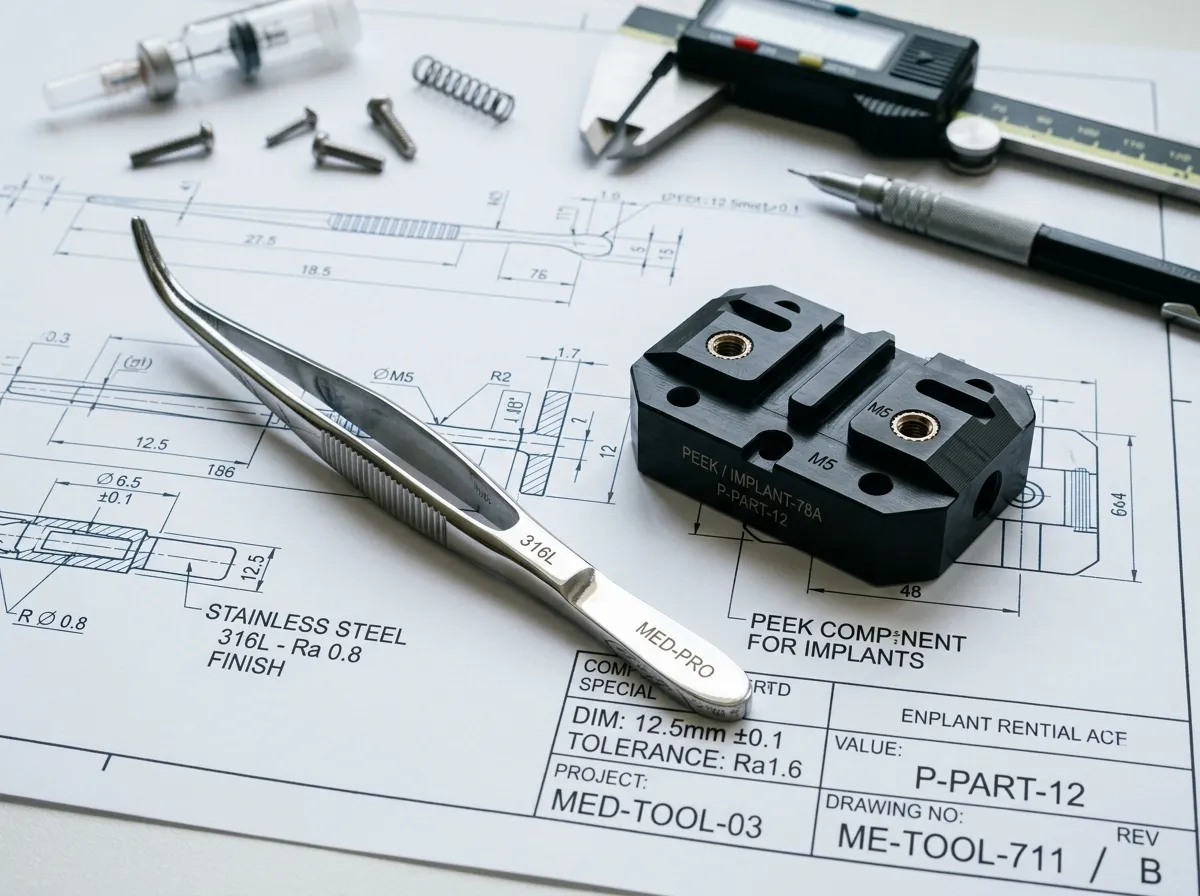
Designing Class I and Class II medical devices—such as surgical instruments, diagnostic equipment housings, and dental tools—presents a unique engineering challenge. Unlike standard consumer products, these components must endure harsh chemical wipe-downs, repeated high-pressure steam sterilization (autoclaving), and strict biocompatibility regulations.
The first critical decision in the Design for Manufacturing (DFM) phase is choosing the right substrate. Should you rely on the proven strength of medical-grade metals, or leverage the lightweight, radiolucent properties of high-performance plastics?
At Aizhuo Precision, we machine both. Utilizing our IATF 16949 zero-defect workflows, we apply automotive-grade precision and full material traceability to medical component manufacturing. Here is an engineer’s guide to navigating the complex landscape of medical materials.
When structural integrity, edge retention, or extreme durability are paramount, metals remain the gold standard.
The “L” stands for Low Carbon. This specific alloy offers exceptional corrosion resistance, making it the default choice for reusable surgical instruments, scalpel handles, and orthopedic drill guides. It comfortably survives thousands of autoclave cycles without degrading or rusting.
While 316L is incredibly corrosion-resistant, it isn’t the hardest steel. For medical tools that require a sharp cutting edge or must withstand extreme mechanical stress (like bone saws or high-torque surgical screwdrivers), 17-4PH (Precipitation Hardening) stainless steel is the superior choice.
Titanium offers the highest strength-to-weight ratio of any CNC machined metal. While famous for implantable devices, it is also heavily used in external fixators, premium dental tools, and wearable medical technology where reducing user fatigue is critical. Furthermore, it is non-magnetic, making it safe for use in MRI environments.

Advances in polymer science have introduced engineering resins that can match—and sometimes exceed—the performance of metals in specific medical applications.
PEEK is one of the most robust engineering plastics in the world. It is highly chemical resistant, withstands repeated autoclaving up to 134°C, and offers excellent mechanical strength.
Polyphenylsulfone (PPSU) is famous for its extreme impact resistance and ability to endure over 1,000 cycles of high-pressure steam sterilization without significant loss of mechanical properties. It is widely used in surgical sterilization trays, medical fluid manifolds, and handpiece housings.
For the external housings of diagnostic machines, patient monitors, and medical carts, high-performance engineering is less about extreme heat and more about structural stability and aesthetic cleanability. Medical-grade Polycarbonate (PC) and PC/ABS blends provide excellent impact resistance and are formulated to withstand aggressive hospital-grade chemical disinfectants without cracking.
You don’t always have to choose just one material. Many modern surgical instruments combine the rigidity of a metal core with the ergonomics of a polymer exterior.
Through our in-house Insert Molding and Overmolding capabilities, Aizhuo Precision routinely machines 316L stainless steel cores and overmolds them with Medical-Grade Liquid Silicone Rubber (LSR) or PPSU. This provides the surgeon with the unwavering strength of a metal tool, combined with a soft, non-slip, and fully autoclavable grip.

In the medical sector, counterfeit or mixed materials can lead to catastrophic device failures or regulatory rejections.
Specifying PEEK or 316L on a CAD drawing is easy; guaranteeing that the material on the CNC machine is authentic is much harder. This is where Aizhuo’s strict Incoming Quality Control (IQC) protects your supply chain.
Before a single chip is cut, every batch of raw metal bar stock and medical-grade resin entering our facility is analyzed using XRF Spectrometers. We verify the exact chemical composition to guarantee authentic material performance, ensuring full compliance with FDA material standards and RoHS directives.
Balancing mechanical properties, sterilization requirements, and machining costs requires deep engineering expertise. Let our materials and DFM experts review your next medical device project.